
Supplement Education / Designs for Health / CogniAid
CogniAid
Educational product guide · Designs for Health
A clear-eyed look at bacopa, huperzine A, and research on memory
Why Patients Ask About CogniAid
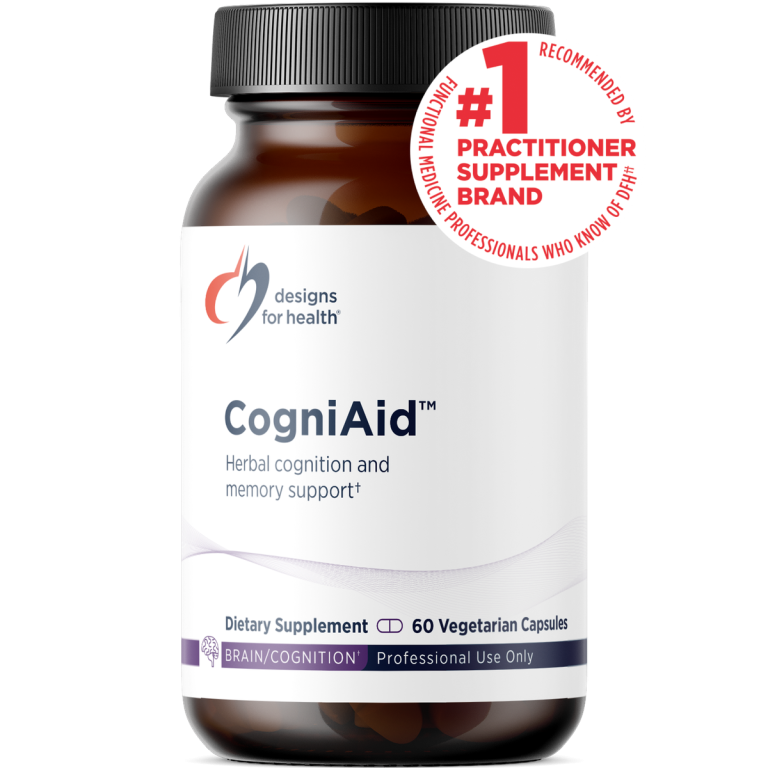
CogniAid is a Designs for Health botanical formula promoted for cognitive wellness and memory support. People may be interested in it because of ordinary lapses in attention, workplace demands, or changes they have noticed with age. These situations are not all the same as mild cognitive impairment, and neither is the same as dementia. An informative guide should clarify what the ingredients do, what the research measured, and why progressive or sudden memory changes deserve medical assessment.
Inside the Formula: What the Ingredients Actually Are
The current formula includes standardized bacopa extract, Memophenol grape-and-wild-blueberry polyphenols, NooGandha ashwagandha, American ginseng, and huperzine A. Bacopa has been used traditionally and evaluated in small clinical cognition trials. Huperzine A slows the breakdown of acetylcholine, a neurotransmitter involved in attention and memory; that biochemical effect does not by itself prove clinical benefit. The other botanical extracts provide complex mixtures, so the combination's interactions and tolerability need to be considered.
What Human Research Says—and What It Does Not
A systematic review of trials involving bacopa found some improvement in memory free recall, with less consistent evidence for other cognitive domains. A meta-analysis of randomized trials reported possible benefits in measures of attention, while a more recent clinical study in mild cognitive impairment produced mixed outcomes. Importantly, this research involved specific bacopa preparations and populations, not CogniAid's complete multi-ingredient blend. There is no verified evidence that the finished supplement prevents dementia or reverses cognitive disease.
Evidence interpretation: Unless explicitly stated otherwise, these studies did not test CogniAid as a finished commercial formula. Research involving an ingredient, dose, or preparation should not be treated as proof of benefit for this product.
Questions Worth Asking Before You Use It
Is ordinary forgetfulness the same as dementia?
No. Sleep, stress, hearing difficulties, medicines, mood, thyroid problems, vitamin deficiencies and many other causes can affect attention and recall. Sudden confusion or rapid neurological changes call for urgent medical assessment.
Does acetylcholine biology prove huperzine A improves memory?
No. A laboratory mechanism and clinically meaningful cognitive benefit are different kinds of evidence. Huperzine A may also interact with medicines that affect acetylcholine.
How should I read a memory-supplement study?
Check who was enrolled, whether researchers used objective memory tests, how long the study lasted, and whether it examined the exact formulation and dose on the bottle.
Safety, Interactions, and When to Seek Care
Huperzine A's cholinergic activity warrants medication review, especially with other medicines that affect acetylcholine. Ashwagandha may interact with thyroid medications and has been linked to rare liver injury; it is generally avoided in pregnancy and breastfeeding. People experiencing new neurological symptoms, worsening memory or medication-related confusion should seek appropriate clinical evaluation rather than self-treating with a supplement.
Before using any new supplement, check the current manufacturer label and review your medications, allergies, pregnancy or nursing status, and health conditions with a qualified healthcare professional.
Related Guides and Ordering Information
For a different type of cognitive formula, read our Membrin education guide. Separate products should not be treated as interchangeable.
Explore other Designs for Health educational guides, or browse the full Supplement Education library.
We do not sell these products online through this website or display prices here. Ask Davis Family Chiropractic about patient ordering options by calling (440) 624-4214.
References and Editorial Transparency
Sources include the official manufacturer details and independent medical research. This guide distinguishes manufacturer descriptions from established clinical evidence.
- Designs for Health: CogniAid current product page
- Systematic review of bacopa randomized trials (PubMed)
- Bacopa randomized trial in older adults (PubMed)
- NCCIH: ashwagandha safety and interactions
Editorial status: Research prepared November 2026. Clinically reviewed by Adam Davis, DC, FNP. Information is educational and not intended to diagnose, treat, cure or prevent any disease. Product ingredients, risks and availability may change.